pyplasmode
Simule resultados a partir de datos de características y evalúe la predicción y la selección de características.

Descargas y Adopción en la Comunidad
Análisis de Salud e Ingeniería (5 Pilares)
1. Gobernanza y Comunidad100 / 200 ▾
2. Metadatos y Empaquetado PEP200 / 200 ▾
3. Seguridad y Cadena de Suministro200 / 200 ▾
4. Documentación, SEO y Ecosistema155 / 200 ▾
5. Ingeniería, CI y Calidad165 / 200 ▾
Documentación Oficial y Guía de Uso — pyplasmode
Mostrar documentación original completa (README en inglés) ▾
PyPlasmode
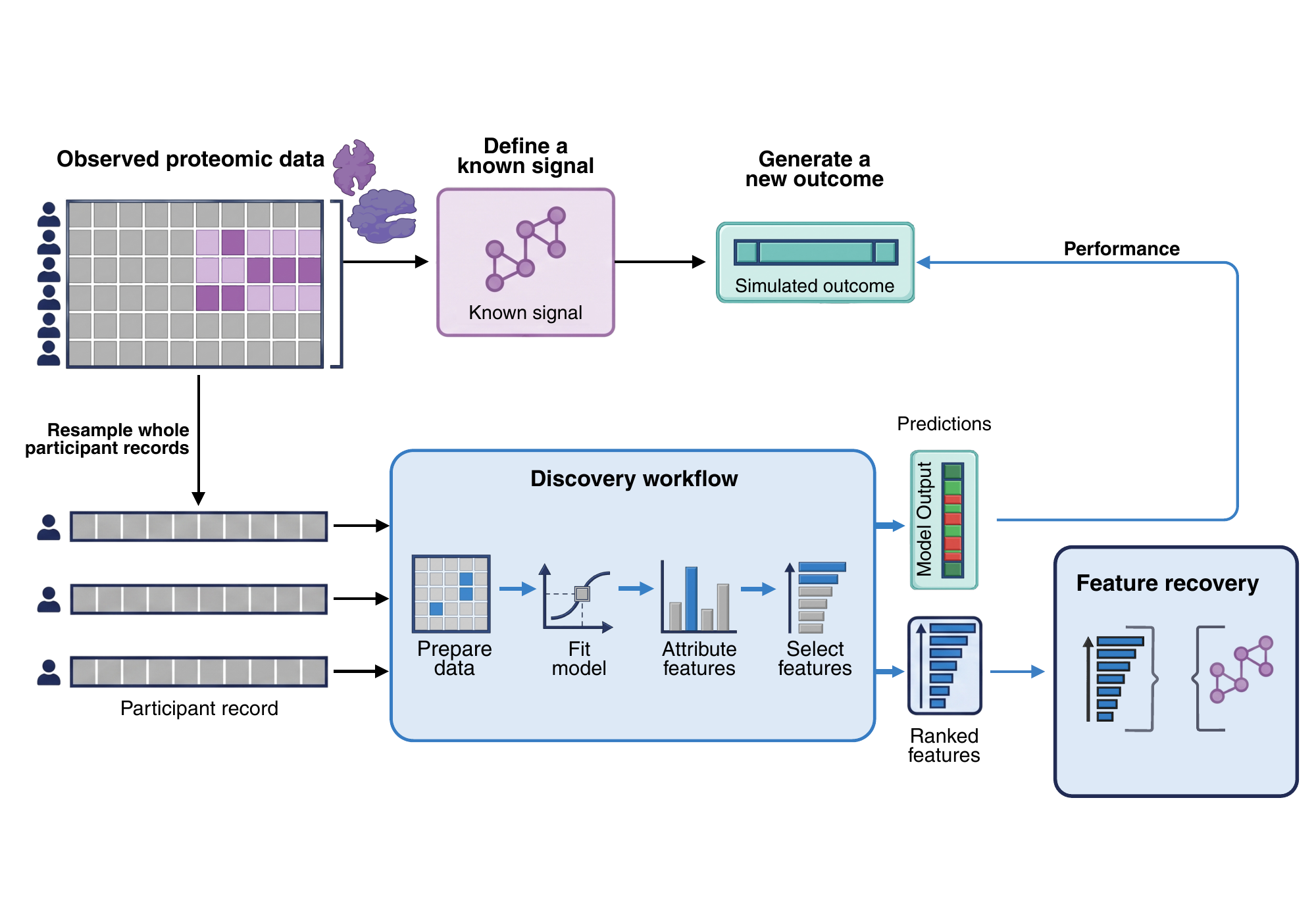
PyPlasmode tests prediction and feature selection against a known signal. It combines your feature data with simulated outcomes to measure how accurately a model predicts them and how well it identifies the generating features used to produce them.
A plasmode uses observed measurements to maintain realistic feature relationships while you control how the outcome is generated. The library was built for biomarker benchmarking and accepts any numeric matrix of observations and named features, including the synthetic matrices below.
You can integrate it with your existing modelling workflow. Generate a dataset, fit and tune your models, then evaluate their predictions, feature rankings, or selected panels.
The visual gallery shows signal structures, recovery among correlated features and the five outcome families. The feature-selection tutorial follows a complete example from correlated measurements through model fitting, attribution and recovery above chance.
Installation
Requires Python 3.12-3.15. Install from PyPI:
python -m pip install pyplasmode
The runtime dependencies are NumPy, SciPy and scikit-learn. To include the reference validation and survival examples:
python -m pip install "pyplasmode[validation]"
Ten-minute example
import numpy as np
from sklearn.linear_model import LogisticRegression
import pyplasmode as ppm

rng = np.random.default_rng(1)
population = ppm.Population(
    rng.normal(size=(2_000, 100)),
    tuple(f"feature_{index}" for index in range(100)),
)

partition = ppm.partition_population(
    population,
    training_fraction=0.6,
    validation_fraction=0.2,
    seed=7,
)
samples = ppm.generate_partitioned(
    partition,
    truth=ppm.SparseTruth(features=("feature_3", "feature_17", "feature_42")),
    outcome=ppm.BinaryOutcome(probability=0.15, odds_ratio=2.0),
    sample_sizes=ppm.PartitionSampleSizes(1_200, 400, 400),
    sampling_method="without_replacement",
    seed=42,
)

train, test = samples.training, samples.evaluation
model = LogisticRegression(max_iter=1_000).fit(train.X, train.outcome.values)
ranking = tuple(train.feature_ids[index] for index in np.argsort(-np.abs(model.coef_[0])))

recovery = ppm.evaluate_ranking(ranking, train.truth, depths=(10, 20, 50))
prediction = ppm.evaluate_prediction(
    test.outcome.values,
    model.predict_proba(test.X)[:, 1],
    metric="roc_auc",
)
print(recovery.at_depth[0].recall)
print(prediction.value)
The first number is the recovery (recall in the API): the fraction of the three generating
features in the model's top ten. The second is the AUC (area under the ROC curve) on held-out
observations. Repeat the comparison with different seeds to estimate average performance and
its Monte Carlo uncertainty. compare_paired_replicates matches two procedures' results by
simulated dataset before computing paired differences, and counts failures among the matched
pairs. See
paired evaluation.
Source rows are split before resampling to keep training, validation and test rows disjoint. This example uses a fixed model. The validation sample is available for tuning hyperparameters.
What can be varied
- Signal: a null, sparse, correlated, distributed or interaction structure, or a custom function.
- Outcome: binary probability, continuous mean and spread, count rate, ordinal category probabilities or cumulative event risks at chosen times. Binary and time-to-event outcomes can take a target AUC of the generating score in place of an odds or hazard ratio (calibration).
- Evaluation: feature and group recovery, weighted-module and graph-region coverage,
reconstruction of the generating score, prediction accuracy, panel performance and ranking
stability. Further functions handle tied scores and incomplete selections and compute
recovery above chance.
pyplasmode.metricsprovides selection stability and consensus across refits, AUC under censoring, paired bootstrap differences and the gap between a fitted model's AUC and that of the generating score.
Start with Methods, then choose a signal and outcome. The evaluation guide defines each result. The validation example checks the generators and recovery metrics against known values and reference estimators. The documentation also holds the API reference.
The executable quickstart,
survival example,
custom signal
and metrics and calibration example
use synthetic inputs. The synthetic benchmark
fits Cox, ridge and XGBoost across three signal structures and three target AUCs, then
compares held-out AUC with recovery above chance in the top 20 features. It needs the
optional model libraries: python -m pip install "pyplasmode[benchmark]".
Using it with a coding agent
The folder skills/pyplasmode
is a skill package that teaches a coding agent the workflow, the choices and the common
mistakes. See Coding agents.
Working with empirical data
Resampling preserves the source data's feature relationships and missingness patterns. It can reproduce individual records, so generated datasets require the same privacy protections as their source. See Data handling.
Licence
PyPlasmode uses the BSD 3-Clause License.